CoinDesk Called It Official. LinkedIn Called It NSFW. We Need to Talk About Consensus.
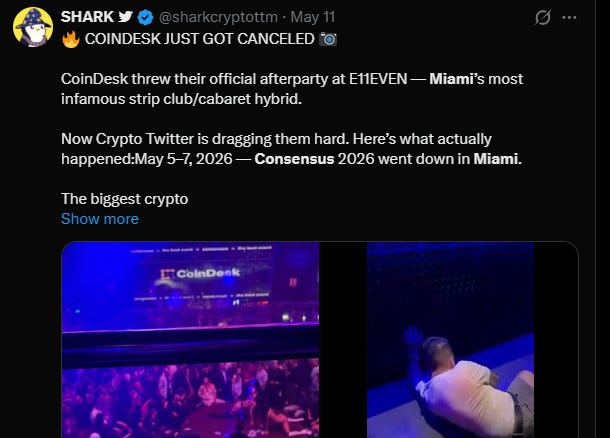
Consensus 2026's official afterparty featured naked women + men urinating on themselves ~ content so explicit LinkedIn refused to show it to you. CoinDesk owes us an apology.

A NOTE FROM KAC:
Not sure what CoinDesk is? It is crypto’s most-recognizable media company, and Consensus is its flagship annual conference, which is considered one of the most powerful gatherings in the industry. The afterparty referenced in this opinion piece wasn’t a rogue side party. This was CoinDesk’s official event.
Let’s start with CoinDesk’s own words.
On CoinDesk’s Consensus 2026 event page, it describes its official events like this: “verified venues, confirmed guest experiences, and direct integration with the Consensus attendee community.”
These are, by Consensus’ own definition, the events they stand behind.
So here is what CoinDesk stood behind at Consensus 2026 in Miami. … Naked and near-naked women used as entertainment. Men - professional attendees at one of the largest crypto conferences in the world - urinating on themselves. Content so graphic that when attendees tried to post footage on LinkedIn, the platform’s own moderation systems flagged it as NSFW and suppressed the posts.
Read that again.
LinkedIn - the professional networking platform - decided that content from CoinDesk’s official, verified, stood-behind Consensus event experience was too explicit for a professional audience.
And, as of today, May 18, 2026, CoinDesk has issued no meaningful public statement addressing what happened at its official event.
As of today, the photos, like the ones here, are still circulating on social media.
And Consensus Wasn’t Even the First Time.
If the Miami afterparty felt like it came out of nowhere, consider what happened just two years earlier across the Atlantic.
At the S+DAS London conference in 2024, crypto custody firm Copper, chaired by Lord Philip Hammond, the former UK Chancellor of the Exchequer, hosted a party where people were served sushi off the bodies of half-naked female models. This was reported in detail by The Times of London. A major national newspaper. A major crypto firm. A former government minister’s name attached to it.
There was some outrage. Some posts. Then the industry moved on - apparently, straight to Miami. London 2024. Miami 2026. Two events, two countries, one industry - and the same message: women are scenery.
“London 2024. Miami 2026. Two events, two countries, one industry - and the same message: women are scenery.”
The pattern isn’t subtle. These aren’t fringe incidents. They’re happening at events organized by, or directly connected to, some of the biggest and most visible names in the entire crypto ecosystem. And the silence that follows each one is its own kind of answer.
It’s Not Just Offensive.
It Has Real Consequences.
Here’s what gets missed every time someone waves things like this off as “just a party.”
The afterparty is not separate from the conference. The party is business. And women are being priced out of it. The relationships that turn into funding rounds, advisory roles, co-founder conversations, and job offers - a huge chunk of them happen after hours. Over drinks. In exactly these rooms.
When those rooms are designed to make women feel like they’re part of the entertainment rather than part of the industry, they leave early. They don’t come back next year. They steer clear of the whole circuit. And quietly, without a single dramatic confrontation, the network closes. The deals happen without them. The industry keeps its shape.
We hear from women in crypto constantly - in DMs, in our emails, in our community, in hushed conversations at side events - about which conferences feel safe and which ones feel like you need to stay alert, stick with people you trust, and get out before it gets weird. That constant calculation is exhausting. And, it is absolutely keeping talented women out of rooms where they belong.
“The afterparty is not separate from the conference. The party is business. And women are being priced out of it.”
Crypto Said It Was the Great Equalizer.
The Parties Say Otherwise.
We’ve heard the pitch a thousand times. Crypto is permissionless. Decentralized. Your wallet doesn’t have a gender. Bitcoin is for everyone. No gatekeepers. No old boys’ networks. Just code and opportunity, open to all.
And then the afterparty happens, and the ideology dissolves.
The gap between what crypto claims to be and what its culture actually looks like at its marquee events is enormous. And it has downstream consequences that go way beyond bad vibes. Culture shapes who builds the technology. Who funds it. Who it gets built for. What problems it actually prioritizes solving.
Women hold a massive share of global wealth and financial decision-making.
Women in underbanked regions stand to gain enormously from DeFi done right. Women investors consistently demonstrate stronger long-term performance. And yet crypto - the movement that was supposed to dismantle old financial power structures - has spent a decade recreating some of the worst aspects of the culture it claimed to replace.
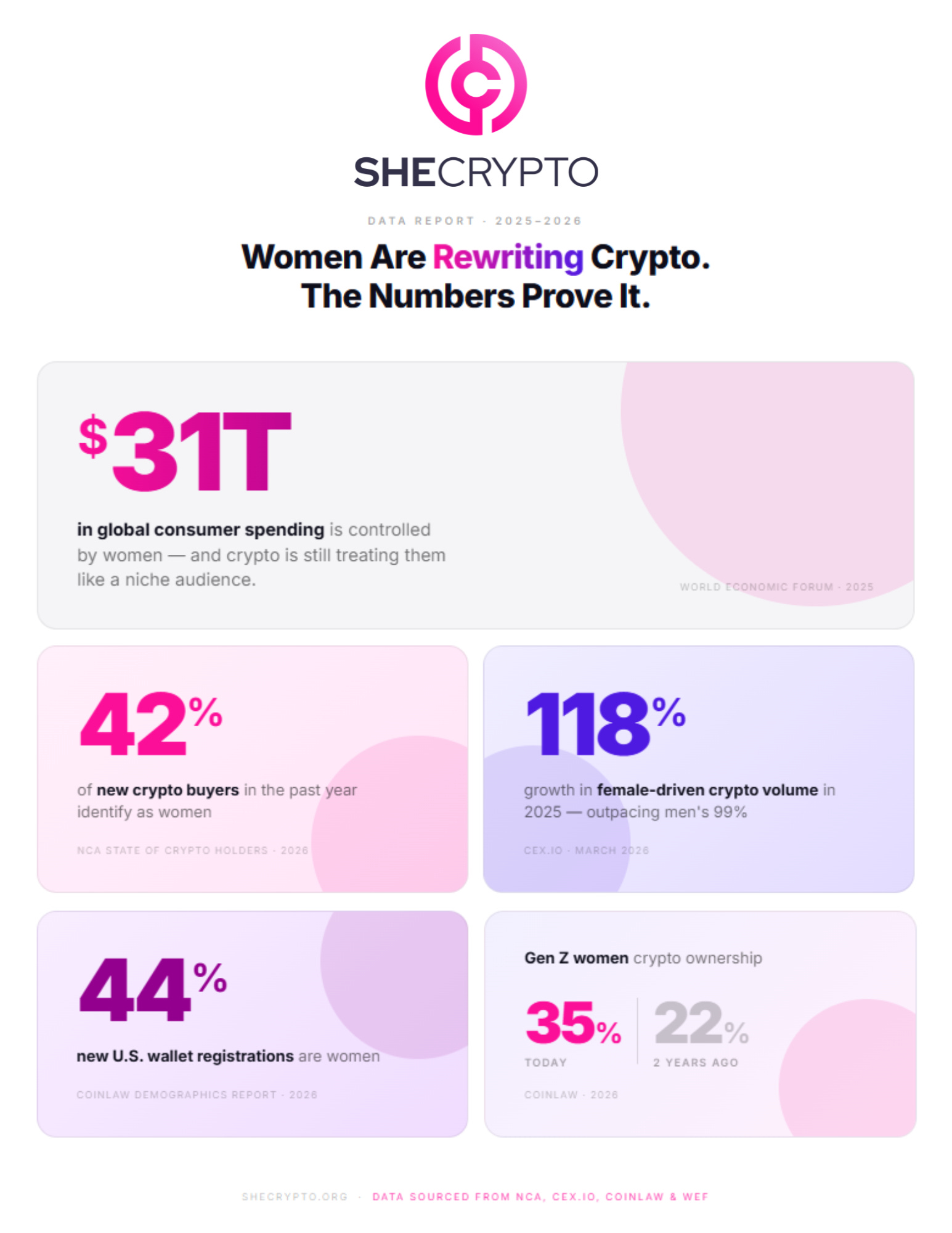
The numbers tell a story of slow but undeniable momentum: women now make up roughly 26% of global crypto investors, up from a fraction of that just a few years ago, and female-driven volume on crypto exchanges surged over 118% in 2025 alone - outpacing men's 99% growth over the same period. Among Gen Z women, ownership has jumped to 35%, up from 22% just two years prior. In the U.S., women now account for 44% of new wallet registrations. The direction is clear.
And here's the stat that should stop everyone in their tracks: according to the 2026 State of Crypto Holders Report by the National Cryptocurrency Association (NCA), "When you separate those who bought crypto for the first time in the past year from those who entered the market over the previous 15 years, the two groups look strikingly different. The newer wave is more likely to be female, with 42% of recent purchasers identifying as women compared to 34% among earlier adopters."
The future of crypto is being written by women - the industry just hasn't caught up yet.
And that gap isn’t just ironic; it’s expensive.
Women control an estimated $31 trillion in global consumer spending. They are the fastest-growing segment of crypto buyers. They hold assets longer and panic-sell less. They are, by nearly every measure, the kind of investor and user this industry should be aggressively courting - and the businesses that recognize that soonest will have an enormous competitive advantage over those that don’t.
When the culture at crypto’s biggest events is actively signaling that women don’t belong at the table, that is not just a moral failure - that is a strategic mistake with a price tag attached and compounding consequences. Products built without women in the room fail to serve women. Protocols designed by all-male teams miss use cases that matter to half the planet. Teams without diverse leadership miss the use cases that will define the next wave of adoption. And in a market this competitive, that kind of self-inflicted blind spot doesn’t stay invisible for long.
The talent pipeline problem and the culture problem are not separate issues. One is causing the other. And the people running this industry on the wrong side of that equation will be the ones who pay for it.
Let’s Also Talk About the Women In The Room
We want to be clear about something - because this conversation can’t happen without it. The women performing at these events are not the problem. We are not angry at them. Not for a second.
Let's be honest about how women end up in these positions. It's not a lack of ambition or intelligence - it's a lack of access.
Women - especially young women, especially women without access to the networks and capital that crypto insiders take for granted - often have very few options that pay that well, that fast. That is a systemic reality. It is not a personal failing. And it deserves to be named plainly rather than glossed over.
When the professional world consistently undervalues women, underpays them, and shuts them out of the rooms where real money is made, survival economics take over. These are women who are often just as sharp, just as driven, and just as capable as any man closing deals in that same room - they just never got the same on-ramp. That's what SheCrypto is here to change. We want every woman who has ever felt like her only currency was her body to know: your mind is worth more. Your ideas have value. And there is a community ready to back you.
The frustration here belongs entirely with the organizers of this event - the executives who stood in that room and thought: yes, this is the right vibe for our industry event. I am personally annoyed at the “bro” culture that has decided, over and over again, that the best way to celebrate success is to turn women’s bodies into décor, into serving platters, into entertainment for a room full of men who are there to chat about financial decisions. Every time a crypto firm books women as props at an industry event, it makes it harder for women to be taken seriously as professionals in the same room.
There is a direct line between those two things. When women’s bodies are literally on the table at a crypto event, every woman trying to get a seat at that table has to work twice as hard to even be seen as a colleague - versus a part of the entertainment. Events like these poison the professional environment for every woman in the building - whether she’s there to perform, to network, to pitch, or to invest.
“Every time a crypto firm books women as props at an industry event, it makes it harder for women to be taken seriously as professionals in the same room.”
The women in crypto who are building companies, managing funds, writing protocols, and growing communities don’t want to be on the table. They want a seat at it. And right now, the industry keeps setting the table in a way that makes that seat feel unwelcoming, unsafe, and, frankly, insulting.
That has to stop. Not because we’re asking nicely. Because the data makes it an existential question for the industry’s own future.
A Direct Word to CoinDesk - and Copper
CoinDesk: you help to define the narrative of this entire industry through your journalism and your events. Consensus is your flagship. You own the branding, you approve the partners, you wrote the language about standing behind verified experiences. So own this one, too, and then actually do something about it.
Copper: you operate at the institutional level, where the professional tone for this industry gets set and signalled to the rest of the market. A former UK Chancellor chairs your board. You serve sushi off women’s bodies at industry events. Those two things cannot coexist with any claim to institutional credibility.
The fact that no one in either room stopped and said, “Should we maybe not do this?” is the entire problem in miniature. When behaviour is this normalized, it stops registering as a choice. That is precisely the moment when it matters most to make a different one - and most revealing that you didn’t.
This Is Exactly Why SheCrypto Exists.
We are not here to ask the existing power structures to be kinder.
We are not here to petition CoinDesk to throw better parties.
We are here to build something different - from the ground up, on our own terms.
SheCrypto is the platform built for women who are already in crypto, almost in crypto, and everywhere in between. Every week, our newsletters deliver news, analysis, and industry coverage that doesn’t treat women as an afterthought - including the founders, builders, investors, and operators that outlets like CoinDesk consistently overlook. Because the women shaping this industry deserve to be on the record, not just in the room.
SheCrypto also partners with industry events to get women through the door - with credentials, not as decoration - and then shows up alongside them, so there’s never that moment of walking into a sea of strangers and wondering where to stand. There’s a gang. You’re in it. If something gets weird you always have someone to call.
For women who want to go deeper, SheCrypto also hosts workshops and meetups that meet members where they actually are - whether that’s understanding your first wallet or structuring a deal. The education is practical, the connections are real, and nobody is networking with an angle.
SheCrypto is not a women’s auxiliary to the main event. SheCrypto is the main event - a professional community that takes women in crypto as seriously as the bros should have from the start.
Women are already in this industry. Already building, already investing, already grinding. They are not waiting for permission. They just deserve spaces that don’t spend the evening reminding them that many of the people in the room see them as guests in someone else’s house. When industry events treat women as props, it is a recruitment problem, a retention problem, a talent problem, an innovation problem, and a credibility problem - all at once.
SheCrypto is our answer to every single one of those.
This is a refund request waiting to happen.
Consensus isn’t cheap. Tickets, travel, hotels - attendees invest serious money to be in these rooms. They attended to network, build, and grow. CoinDesk gave them an afterparty LinkedIn flagged as NSFW.
It’s also a failure to set an example for men.
Good men in this industry showed up to do business - and were handed an environment that normalized exactly the culture they should be pushing back against. The next generation of men in crypto is watching and learning the standard. Right now, the industry’s biggest event is setting that standard in the worst possible way. Leadership isn’t just about what you build. It’s about what you allow. And CoinDesk allowed this.
That’s not a guest experience. That’s a refund request waiting to happen.
CoinDesk owes all of us an apology.
— Kelly Ann Collins
Founder of SheCrypto
You are not the décor.
You are the industry.
Join the community that’s building the crypto world
women deserve ~ and actually want.